My research examines how institutional and market frictions shape productivity, innovation, and the allocation of economic opportunities. My work combines structural and general-equilibrium modeling with quantitative policy analysis, spanning spatial economics, digital competition, and technological change.
Building on these foundations, I am developing a research agenda in the economics of artificial intelligence, focusing on market structure and innovation, international trade and economic development, and the implications of technological change for labor markets and human capital.
Peer-Reviewed Publications
Infrastructure and Development
Why is household electricity uptake low in Sub-Saharan Africa?
Moussa P. Blimpo, Agnieszka Postepska, and Yanbin Xu
Expanding electricity infrastructure does not guarantee that households will connect.
Combining household and community surveys from more than 30 Sub-Saharan African countries with qualitative fieldwork, we decompose the electricity-access deficit into supply- and demand-side constraints. Demand-side factors account for approximately 41% of the deficit overall, with particularly large contributions in urban areas. Beyond income levels, income regularity, housing quality, and complementary community infrastructure are important predictors of electricity uptake.
These findings suggest that expanding the grid alone may not achieve universal access. Electrification policies must also address household financing constraints, payment flexibility, and opportunities to use electricity productively.
View research figure
Demand-side share of the electricity-access deficit
0%100%
All areas41%
Urban78%
Rural35%
Source: Table 2. Rounded shares from the statistical decomposition of the electricity-access deficit: 41% in all areas, 78% in urban areas, and 35% in rural areas. These are shares attributed to demand-side constraints, not household connection rates or causal policy effects.
Working Papers
Digital Markets, Regulation, and Innovation
From Market Opening to Innovation: Effective Contestability in Digital Markets
Opening a digital market can make entry viable without making innovation viable.
Why can a challenger enter a newly opened digital market yet remain unable to innovate? I develop a two-period stochastic general-equilibrium model that embeds a strategic game between a dominant platform and a potential rival, with endogenous entry and investment in incremental and disruptive innovation. The model distinguishes effective market access from inherited competitive advantages in quality, productivity, and innovation capability, identifying separate thresholds for commercially viable entry and sustained rival innovation.
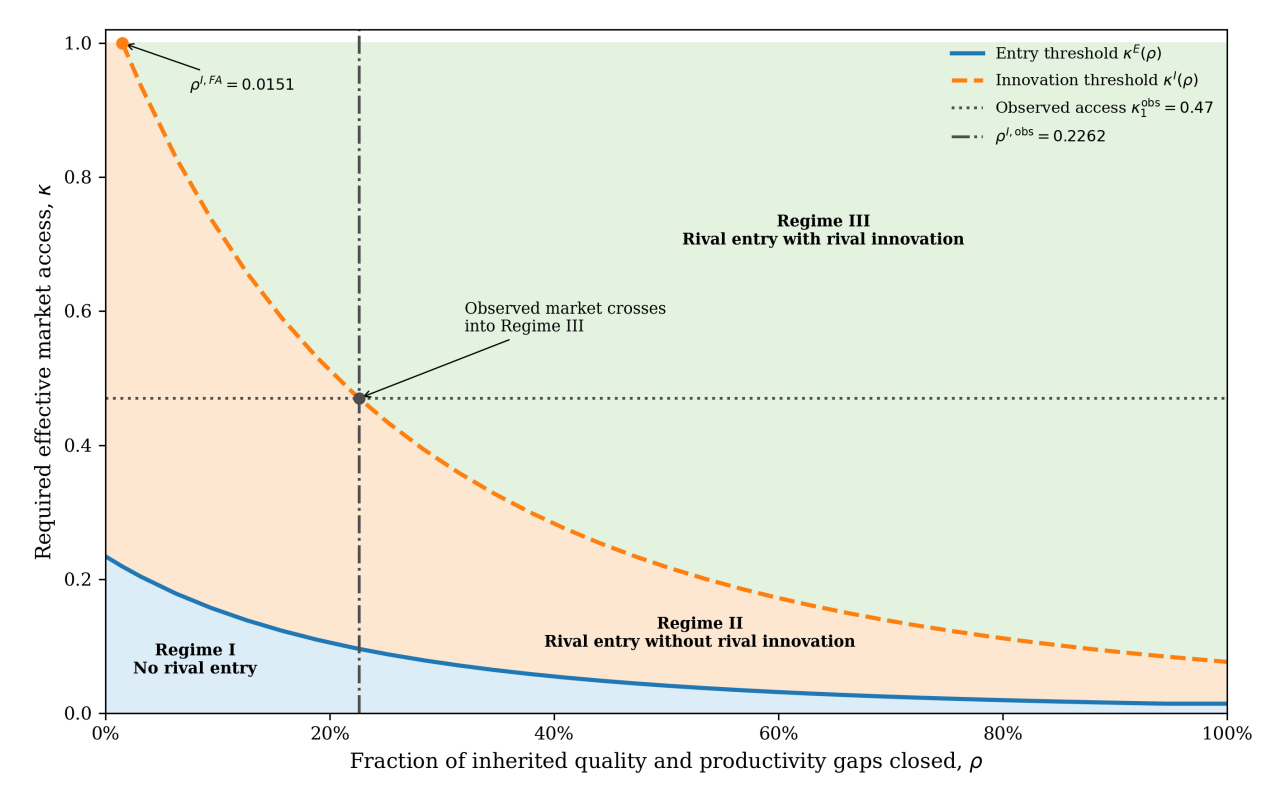
Calibrated to EU iOS app distribution following the Digital Markets Act, the model shows that observed access supports challenger entry but not innovation. Even full effective access is insufficient to induce rival innovation in the benchmark; stronger inherited capabilities or innovation efficiency can change that outcome. Greater access can also stimulate incumbent innovation despite lower profits, while welfare gains extend beyond the digital sector through downstream production linkages.
The central implication is that formal market opening, commercial viability, and dynamic contestability are distinct tests of competition policy effectiveness.
View research figureMarket opening can support rival entry before it supports innovation. Closing inherited quality and productivity gaps lowers the effective-access threshold required for rival innovation.
Figure 7, September 2026 draft: entry and innovation regimes along the less-disadvantaged rival path. Closing 22.62% of each inherited quality and productivity gap brings the innovation threshold to observed effective access (κ = 0.47). Slightly greater gap closure supports positive rival innovation. Source: paper, p. 44 .Digital Markets, Regulation, and Innovation
Beyond Market Concentration: Measuring Contestability in Digital Markets
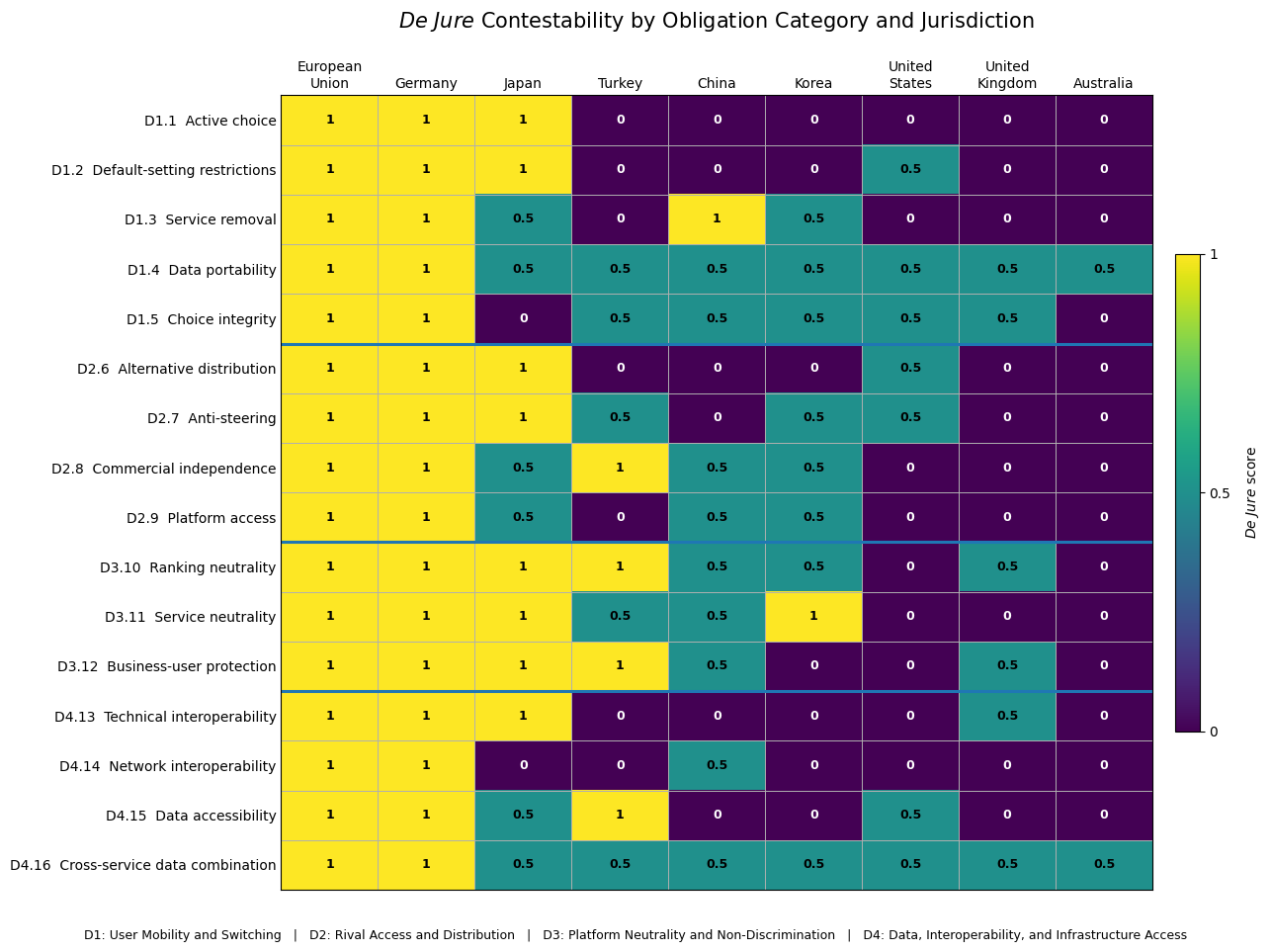
Market concentration tells us which firms dominate a market, but not whether their positions can be challenged. This paper develops a multidimensional framework for measuring digital-market contestability as competitive opportunity rather than observed market structure or outcomes. It distinguishes De Jure Contestability, the legal protections supporting competitive challenges, from De Facto Contestability, the extent to which those opportunities operate in practice.
The framework examines user mobility, rival access and distribution, platform neutrality, and access to data and infrastructure. Its initial implementation includes 144 legal assessments across nine jurisdictions and market-level applications to Google Search, Apple iOS/App Store, and Google Android/Google Play. The analysis reveals substantial differences between formal regulatory protections and realized competitive opportunities, providing a framework for comparing regulatory regimes and evaluating implementation.
View research figureFigure: De jure contestability across jurisdictionsMobility and Spatial Growth
Internal Migration Restrictions, Aggregate Productivity, and Spatial Growth
Yanbin Tracy Xu
Job-market paper · Submitted · Razin Prize (2025).
How do institutional barriers to migration affect long-run economic growth? I develop a dynamic spatial general-equilibrium model that distinguishes China's hukou-related migration restrictions from conventional geographic mobility costs. The framework incorporates endogenous agglomeration-driven productivity and local amenities shaped by congestion and rent-financed public investment.
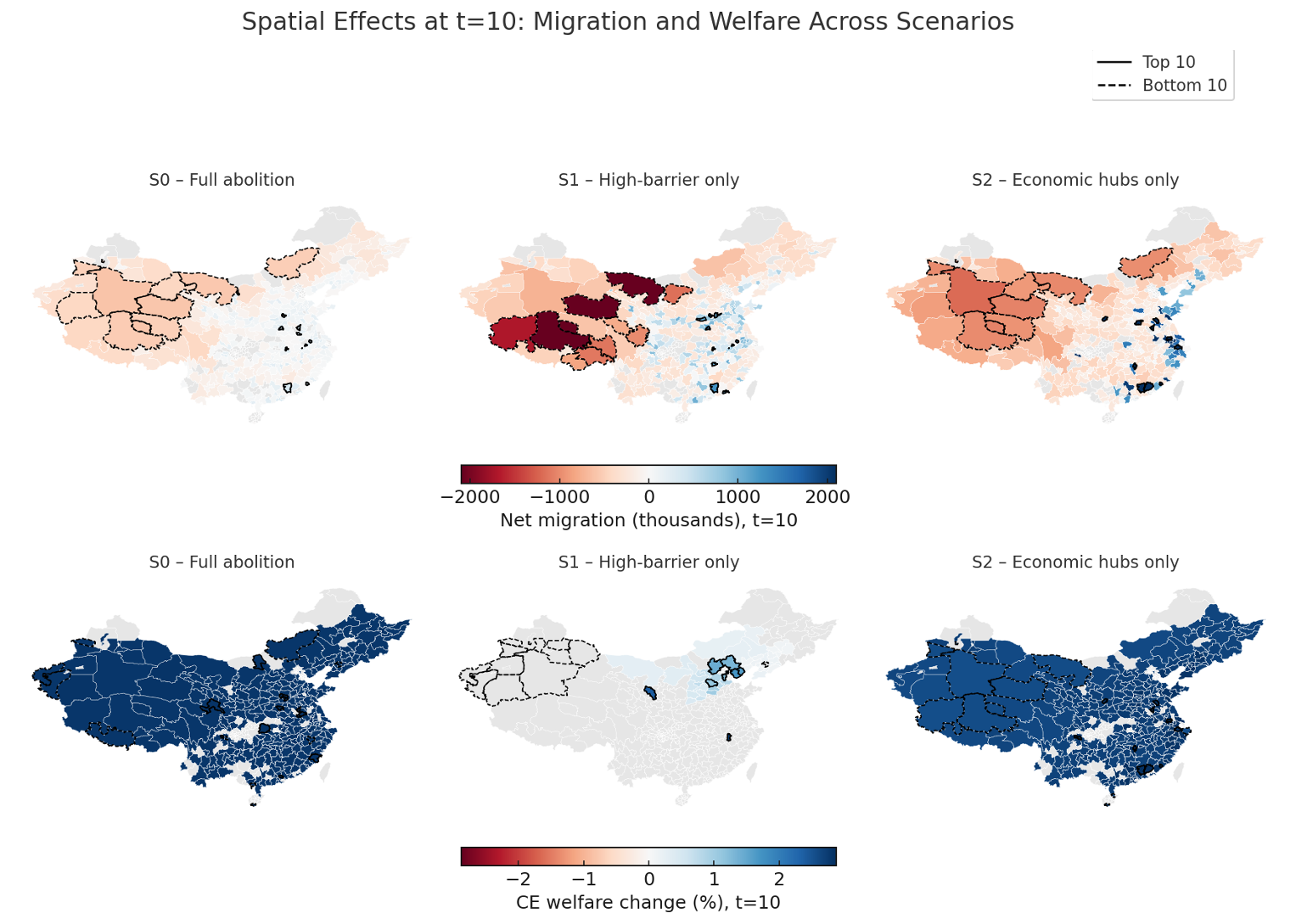
Calibrated to Chinese prefecture-level data, the model shows how migration restrictions impede labor reallocation toward more productive regions and weaken long-run productivity growth. Counterfactual simulations suggest that full reform could raise consumption-equivalent welfare by approximately 53% over a century, although the gains vary considerably across regions and reform designs.
The central contribution is to demonstrate how institutional migration barriers affect not only the current allocation of labor but also the long-run evolution of productivity, public investment, and spatial inequality.
View research figureFigure: Who moves and who benefits? Simulated effects of hukou reform after 100 yearsHuman Capital and Digital Transformation
Technology in the Classroom and Learning in Secondary Schools
Moussa P. Blimpo, Ousman Gajigo, Solomon Owusu, Ryoko Tomita, and Yanbin Xu
World Bank Policy Research Working Paper No. 9288 (2020).
Can technology-assisted instruction improve learning outcomes in resource-constrained schools?
We evaluate a computer-assisted mathematics and science education program in The Gambia using administrative and survey data and a quasi-experimental design with matched comparison groups. Estimates from the national secondary-school certification examination indicate a 0.59-standard-deviation improvement in mathematics scores and a 15-percentage-point increase in the share of students achieving satisfactory grades in both mathematics and English—a requirement for university admission.
The gains are concentrated among students with stronger baseline academic performance, highlighting both the potential of technology-assisted instruction and the importance of ensuring that educational innovations benefit students across the achievement distribution.
View research figure
Estimated examination outcomes
+0.59standard deviations
Mathematics examination scores
+15percentage points
Students achieving satisfactory grades in both mathematics and English
Estimates from a nonrandom, quasi-experimental evaluation with matched comparison groups in The Gambia. Outcomes are measured on the national secondary-school certification examination. Satisfactory grades in both subjects are required for university admission. The panels use different units and do not share a numeric axis.
Policy Research and Reports
Digital Markets, Regulation, and Innovation
Comments on the First Review of the Digital Markets Act
Fiona Scott Morton, Alissa Cooper, Jacques Crémer, Amelia Fletcher, Paul Heidhues, Giorgio Monti, Rupprecht Podszun, Alexandre de Streel, and Tracy Xu
Yale Tobin Center for Economic Policy · Policy research, 2026.
How can the Digital Markets Act turn formal obligations into effective competitive opportunities? This joint policy submission reviews implementation and enforcement and proposes reforms to compliance reporting, independent benchmarking, and performance indicators. It also examines messaging interoperability and the potential application of the DMA to artificial intelligence. The recommendations focus on making compliance independently assessable and strengthening implementation; they are policy proposals, not estimates of the regulation’s causal effects.
Digital Markets, Regulation, and Innovation
Designing the Technical Committee for the United States v. Google Search Antitrust Remedy: A Blueprint for Effective Implementation
Contributors: Zander Arnao, Felix Chen, Alissa Cooper, Timothy Cowen, Joseph Jerome, Michael Kraver, Karina Montoya, Tracy Xu, and Sophia Yakhno
Knight–Georgetown Institute · Policy report, April 2026.
This report proposes an institutional design for overseeing remedy implementation in United States v. Google LLC. Drawing on the Microsoft remedy and recent regulatory experience, it sets out technical access, authority, and monitoring procedures to address information asymmetries and support effective enforcement.
Work in Progress
Human Capital and Digital Transformation
Digital Skills and Labor Market Demand in Central Asia
Yanbin (Tracy) Xu
Work in progress.
Research summary
This project examines how digital competencies relate to employment, wage premia, and skills mismatch in Central Asia, using employer surveys, wage data, and skills assessments.
Human Capital and Digital Transformation
Digital Skills for Lifelong Learning (DS4LL), Kyrgyzstan
Yanbin (Tracy) Xu
Work in progress.
Research summary
An impact evaluation of digital skills training and competency development across approximately 300 secondary schools in Kyrgyzstan. The project combines student and teacher assessments with implementation data to study learning and institutional capacity. The associated World Bank policy research report is pending final institutional approval.
Mobility and Spatial Growth
High-Speed Rail: Impacts on Mobility Costs and Spatial Reallocation
Yanbin (Tracy) Xu
Work in progress.
Research summary
This project extends my spatial framework to study how reductions in transportation costs interact with institutional migration frictions. It examines how high-speed rail changes regional specialization, labor allocation, and productivity—and how those effects depend on the migration regime.
Digital Markets, Regulation, and Innovation
The Economics of Artificial Intelligence: Market Structure, Innovation, and Welfare
Yanbin (Tracy) Xu
Research in development.
Research summary
Developing economic frameworks to study how AI market structure, access to key inputs, and firms’ capabilities affect competition, innovation incentives, and welfare.